Zulip
This page documents a legacy sink in Robusta classic
For new setups, we recommend HolmesGPT instead.
HolmesGPT triages your alerts instead of just forwarding them. Sinks are deterministic: they send every notification, unchanged, to a fixed destination, leaving you to read and prioritize each one yourself.
HolmesGPT instead uses AI to investigate each alert, surface the likely root cause, and escalate only what needs attention — so you get fewer, more actionable notifications. Set this up with Alerts Triage for alerts, or Triggered Workflows for custom events.
Robusta can report issues and events in your Kubernetes cluster to Zulip.
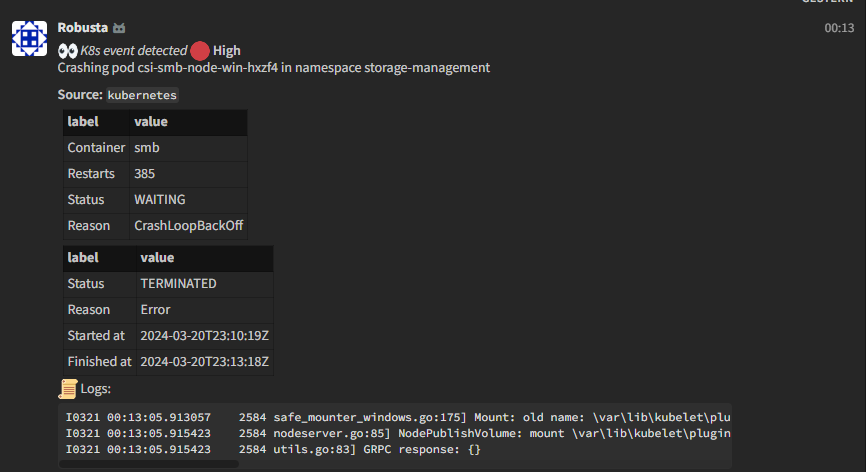
To configure the Zulip sink you will need a bot email, an api token and your api/zulip url
Creating a bot account
Open Zulip
Click on the gear icon in the upper right corner
Select Personal or Organization settings
On the left, click Bots
Click Add a new bot
Fill out the fields, and click Add
Copy email and token
Settings
api_url: The url of your Zulip instancebot_email: The email of the bot accountbot_api_key: The api key of your bot accountstream_name: Name of the channel to send the message totopic_name: Name of the topic of the stream to send messages totopic_override: Dynamic topic override, same as the channel_override in the slack sinklog_preview_char_limit: [Optional - default:500] The amount of log characters to append to the alert message (zulip doesnt have a builtin text file preview). If set to0a text file will be sent
Configuring the Zulip sink
Add this to your generated_values.yaml
sinksConfig:
- zulip_sink:
    name: my_zulip_sink
    api_url: https://my-zulip-instance.com
    bot_email: bot12345@my-zulip-instance.com
    bot_api_key: very_secret_key
    stream_name: Monitoring
    topic_name: Robusta
Save the file and run
helm upgrade robusta robusta/robusta -f generated_values.yaml
You should now get alerts in Zulip!