Jira
This page documents a legacy sink in Robusta classic
For new setups, we recommend HolmesGPT instead.
HolmesGPT triages your alerts instead of just forwarding them. Sinks are deterministic: they send every notification, unchanged, to a fixed destination, leaving you to read and prioritize each one yourself.
HolmesGPT instead uses AI to investigate each alert, surface the likely root cause, and escalate only what needs attention — so you get fewer, more actionable notifications. Set this up with Alerts Triage for alerts, or Triggered Workflows for custom events.
Robusta can automatically open and (optionally) resolve Jira tickets, based on issues in your Kubernetes cluster.
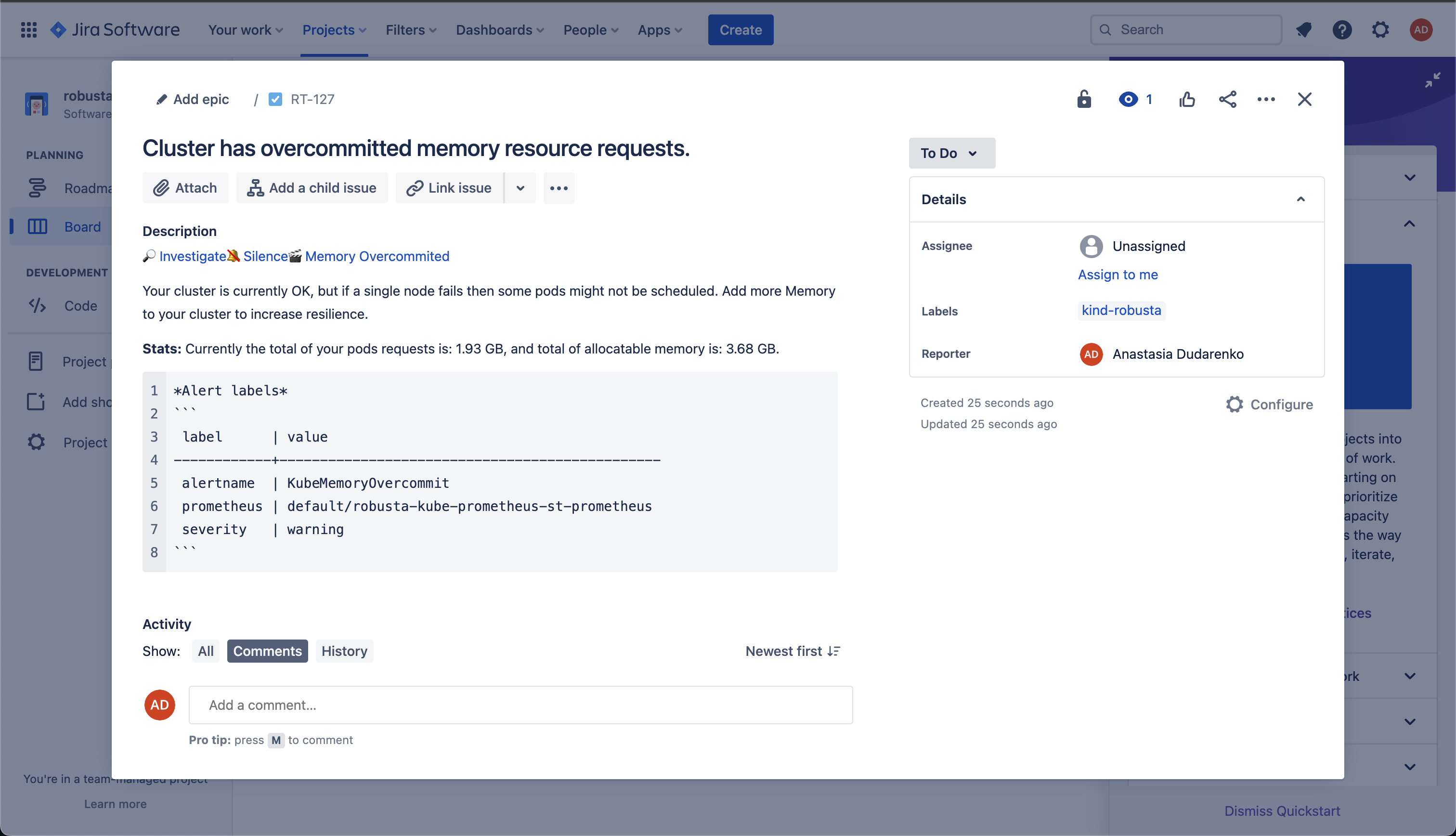
To configure the Jira destination you need to have following:
Prerequisites
url: The url of your workspace. For example: https://workspace.atlassian.net (Note: schema (https) is required)username: The email you use to log into your Jira account. Eg: jira-user@company.comapi_key: Follow these instructions to get your api key.project_name: Project you want the Jira tickets to be created in. Go to Project Settings -> Details -> Name.
Note
The configured user should have the following permissions:
write:jira-work,read:jira-work
Optional Settings
issue_type: [Optional - default:Task] Jira ticket typepriority_mapping[Optional] Maps Robusta severity levels to Jira priorities. Example:priority_mapping: HIGH: "High" LOW: "Low" INFO: "Lowest"
dedups: [Optional - default:fingerprint] Tickets deduplication parameter. By default, Only one issue perfingerprintwill be created. There can be more than one value to use. Possible values are: fingerprint, cluster_name, title, node, type, source, namespace, creation_date etcproject_type_id_override: [Optional - default: None] If available, will override theproject_nameconfiguration. Follow these instructions to get your project id.issue_type_id_override: [Optional - default: None] If available, will override theissue_typeconfiguration. Follow these instructions to get your issue id.assignee: [Optional - default: None] Jira ID of the person that the issue is assigned to.epic: [Optional - default: None] Jira ID of the epic that the issue is linked to.
Following optional settings only work for Prometheus alerts:
sendResolved: [Optional - default: false] If true, will transition a Jira issue to "Done" when the alert event contains a "resolved" status.reopenIssues: [Optional - default: false] If true, will reopen a "Done" Jira issue when an alerts fire with the same fingerprint. If false, a new issue will be created.doneStatusName: [Optional - default: 'Done'] The name of the "Done" status in Jira. Will be used to identify "Done" tasks in Jira.reopenStatusName: [Optional - default: 'To Do'] The name of the "To Do" status in Jira. Will be used to identify "To Do" tasks in Jira.noReopenResolution: [Optional - default: ''] The name of a target Jira resolution that, if present on a Jira issue, prevents Robusta from re-opening it. If this value is present, it makes Robusta ignore thereopenStatusNameconfig.
Configuring the Jira sink
CPUThrottlingHigh and KubePodCrashLooping Prometheus alerts.Add this to your generated_values.yaml
sinksConfig:
  - jira_sink:
    name: personal_jira_sink
    url: https://workspace.atlassian.net
    username: username
    api_key: api_key
    dedups: (OPTIONAL)
      - fingerprint
    assignee: user_id of the assignee(OPTIONAL)
    epic: epic_id(OPTIONAL)
    project_name: project_name
    priority_mapping: (OPTIONAL)
      HIGH: "High"
      LOW: "Low"
      INFO: "Lowest"
    scope:
      include:
        - identifier: [CPUThrottlingHigh, KubePodCrashLooping]
Save the file and run
helm upgrade robusta robusta/robusta --values=generated_values.yaml
Try the example below to receive an alert notification in Jira.
Test your Jira Prometheus Integration
The command below creates a crashing pod which triggers the KubePodCrashLooping alert. This will cause a Jira ticket to be opened when using the above example.
kubectl apply -f https://raw.githubusercontent.com/robusta-dev/kubernetes-demos/main/crashpod/broken.yaml
Note
If creating issues by
project_nameorissue_typefails, try specifying the corresponding ids usingproject_type_id_overrideandissue_type_id_override. Check Optional Settings above for details.